Is there an app for shopping addiction?
You've tried promising yourself. You've tried deleting Amazon. The packages keep coming. Here's what actually puts something between you and the checkout button.
Yes. Hinder is an iPhone app that connects to your bank and locks every shopping app you pick once your monthly shopping budget is spent. The urge hits a locked screen instead of a checkout page. Apple Screen Time, one sec, CartPause, Privacy.com, and your bank's card lock add friction too. None replace therapy if buying feels out of control.
Which apps help with compulsive buying?
Six tools, all available in the US, each stopping you at a different point. Every detail below comes from the company's own site, App Store listing, or help docs, checked in November 2026.
| App | What it does | Where it stops you | Cost | Platform |
|---|---|---|---|---|
 Hinder | Locks your shopping apps when your shopping budget hits 100%, warns at 80% | Before the app even opens, based on what you actually spent | Free to download, 1-week free trial | iPhone |
| Apple Screen Time | Daily time limit on the Shopping & Food category | After a set number of minutes, whatever you spent | Free, built in | iPhone, iPad, Mac |
 one sec | A breathing pause and a check-in before a flagged app opens | Every single open | Free for one app; Pro $6.99/mo or $19.99/yr | iPhone, iPad, Mac, Android, browsers |
 CartPause | Holds items you share to it for 24, 48, or 72 hours | Between wanting it and buying it | Free; Pro $1.99/mo | iPhone, iPad, Mac |
 Privacy.com | Virtual cards with monthly spend limits, locked to one store | At checkout, when the card declines | Free plan, 12 cards a month | Web, browser extension, iPhone |
| Your bank's card lock | Freezes new purchases on a card from the bank app | At checkout, until you switch it back on | Free | Your bank's app |
Hinder- What it does
- Locks your shopping apps when your shopping budget hits 100%, warns at 80%
- Where it stops you
- Before the app even opens, based on what you actually spent
- Cost
- Free to download, 1-week free trial
- What it does
- Daily time limit on the Shopping & Food category
- Where it stops you
- After a set number of minutes, whatever you spent
- Cost
- Free, built in
one sec- What it does
- A breathing pause and a check-in before a flagged app opens
- Where it stops you
- Every single open
- Cost
- Free for one app; Pro $6.99/mo or $19.99/yr
CartPause- What it does
- Holds items you share to it for 24, 48, or 72 hours
- Where it stops you
- Between wanting it and buying it
- Cost
- Free; Pro $1.99/mo
Privacy.com- What it does
- Virtual cards with monthly spend limits, locked to one store
- Where it stops you
- At checkout, when the card declines
- Cost
- Free plan, 12 cards a month
- What it does
- Freezes new purchases on a card from the bank app
- Where it stops you
- At checkout, until you switch it back on
- Cost
- Free
Is shopping addiction a real thing?
Yes, and it's more common than it feels when you're the one hiding the boxes. A 2016 meta-analysis in the journal Addiction pooled 40 studies and estimated compulsive buying at about 4.9% of adults in representative samples, and higher among university students. The World Health Organization's ICD-11 lists compulsive buying-shopping disorder as an example under other specified impulse control disorders. The DSM-5-TR, the manual most US clinicians use, doesn't give it its own diagnosis, which is part of why so many people never hear it named.
This is a money article, not a diagnosis. But if the pattern below sounds like your week, you're not weird and you're not alone.
Why does online shopping feel so hard to stop?
Because the good part happens before you pay. Browsing, adding to cart, picturing the thing arriving. That's the high. Checkout is the comedown, and the box on the porch three days later barely registers. Then comes the guilt, and guilt is a great reason to go browse again.
Stores know this. One-tap checkout, saved cards, flash sales with countdown timers, push notifications at 10pm. Every one of them removes a second where you might have changed your mind. Add the stuff nobody talks about, like tossing packaging before anyone sees it or splitting purchases across cards so no statement looks too bad, and you've got a loop built to run without you noticing.
That's why "just stop" doesn't work. The decision happens in the worst possible moment, when the urge is loudest and the friction is zero. So the fix is moving the decision somewhere else.


What actually helps with shopping addiction?
Friction, money barriers, other people, and for a lot of people, therapy. Apps cover the first two. You need to find the last two yourself.
- Friction. Anything that adds seconds between the urge and the purchase. Delete saved cards, kill store notifications, put a waiting period on wants. Our guide to quitting Temu and Shein goes app by app.
- Money barriers. A hard stop that doesn't care how convincing you are at midnight. A card that declines, or a shopping app that won't open once the month's budget is gone.
- Accountability. Hiding is fuel. Tell one person what you spent this month. Have a partner or friend set your Screen Time passcode so you can't quietly undo your own limits.
- Therapy and support groups. The thing apps can't do: figure out what the shopping is doing for you. More on that below.
How does each app stop you from shopping?
Each one fires at a different moment. The best setups stack two or three.
 1. Hinder: locks shopping apps when the money runs out
Free to download, 1-week free trial · iPhone · Trigger: your real spending
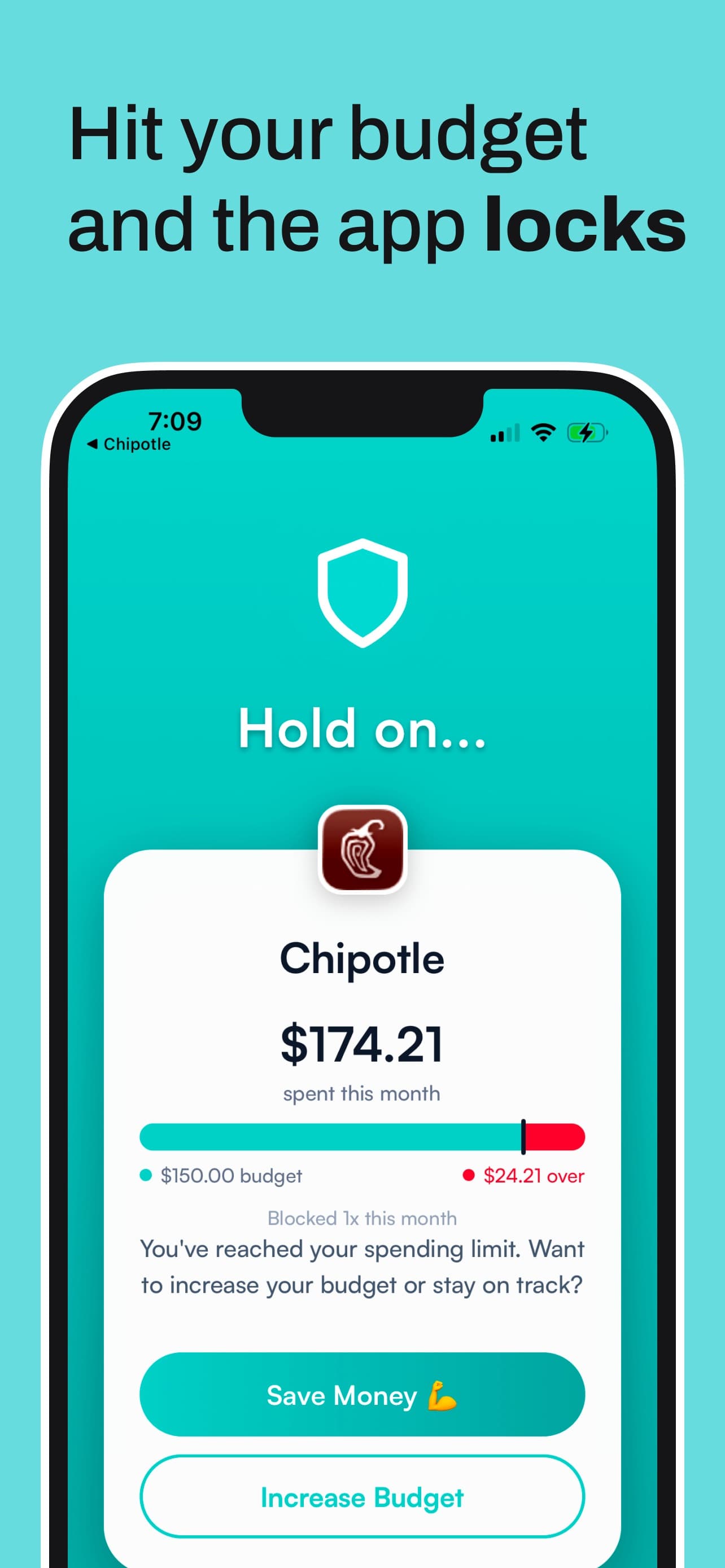
Hinder is the only tool here that knows what you've actually spent. It connects to your bank and cards through Plaid and tracks spending against monthly limits you set by category and by app. You get a warning at 80%. At 100%, it uses Apple's Screen Time to lock the connected apps, so blowing your shopping budget locks Amazon, Temu, Shein, Target, and every other shopping app you added, all at once.
The block screen gives you two choices: Save Money or Increase Budget. There's a short temporary unblock of about five minutes for genuine needs, but the only real way back in is raising your own limit, on purpose, in the cold light of Hinder's budget screen. For a compulsive buyer that pause is the whole point. Under budget, nothing is locked and nobody's nagging you.
It's iPhone only, limits are monthly, and it's free to download with a subscription after the 1-week free trial. No ads, and it never sells your financial data. We compared it against six other blockers in apps that actually stop you from spending money.
2. Apple Screen Time: free, already on your phone
Free · iPhone, iPad, Mac · Trigger: minutes used
Settings, Screen Time, App Limits, Add Limit, then check Shopping & Food. That caps how long you can spend in those apps each day. It's free and it's a decent start, especially if someone you trust sets the passcode. The catch: it counts minutes, not dollars. Checking out on Amazon takes about forty seconds. Our step-by-step guide to blocking shopping apps on iPhone covers the setup and the loopholes, and Screen Time for spending explains why time limits miss the money.
 3. one sec: a forced breath before the app opens
Free for one app; Pro $6.99/mo or $19.99/yr · iPhone, iPad, Mac, Android, browsers · Trigger: every open
one sec intercepts the apps you flag and makes you take a slow breath before they open, then asks if you still want in. It was built for social media, and its makers cite peer-reviewed research with the Max Planck Institute and Heidelberg University showing a 57% drop in app opens. For shopping, it breaks autopilot: the thumb that opens Shein without asking you first. It's free for one app, which is enough if you have one problem store.
 4. CartPause: a waiting room for everything you want
Free; Pro $1.99/mo · iPhone, iPad, Mac · Trigger: a 24 to 72 hour timer
Instead of buying, you share the item to CartPause from any store and pick a 24, 48, or 72 hour timer. When it ends, you decide if you still want it. This one targets the "add to cart" high directly, because you still get to do the wanting, just not the buying. Pausing items is free with no cap; Pro adds savings insights and a widget. If impulse purchases are your main issue more than a compulsion, our guide to apps that stop impulse buying goes deeper.
 5. Privacy.com: cards that decline when you hit the limit
Free plan, 12 cards a month · Web, browser extension, iPhone · Trigger: a spend limit at checkout
Privacy.com gives you virtual cards that draw from your checking account. Each card can carry its own monthly spend limit and can be locked to the first store you use it at. Make an Amazon card with a $75 monthly limit, delete every other card saved in Amazon, and purchase number four of the month just declines. You can also pause a card entirely. The free Personal plan covers all of that. It's US only and needs a US checking account, which is exactly who this post is for.
6. Your bank's card lock: the emergency brake
Free · Your bank's app · Trigger: you flip a switch
Most big US banks let you lock a card from their app. Chase, for example, has Lock & Unlock under Manage account, and it blocks new purchases instantly. Two warnings from Chase's own docs: a lock doesn't stop recurring charges, and purchases through a digital wallet like Apple Pay can still go through. It's a brake, not a budget. If you want a real cap, see whether you can set a spending limit on your debit card.
When should you get professional help for compulsive buying?
When it's costing you more than money. Apps handle the checkout. They don't handle why you're there. Talk to a therapist if you're hiding purchases from people you live with, carrying debt you can't see a way out of, buying to calm anxiety or a low mood, or breaking every limit you set.
Therapy for this has real evidence behind it. A randomized controlled trial in the Journal of Clinical Psychiatry found that 12 weeks of group cognitive behavioral therapy built for compulsive buying significantly reduced it compared with a waiting list, and the gains held at six months. Ask a therapist whether they work with compulsive buying or impulse-control issues specifically.
For free support, Debtors Anonymous is a 12-step fellowship for people whose spending and debt are hurting their lives. It runs in-person, phone, and online meetings across the US, and there are no dues. If shopping is tangled up with thoughts of hurting yourself, call or text 988 to reach the Suicide & Crisis Lifeline any time.
How do you set up Hinder for shopping addiction?
About five minutes, and the hardest part is picking an honest number.
- Download Hinder and connect your bank and cards through Plaid.
- Create a shopping budget with a monthly limit you'd be fine with if a friend saw it.
- Add every shopping app you use: Amazon, Temu, Shein, Target, TikTok, the boutique app you don't want to admit to.
- Let the 80% warning give you notice, and let the 100% lock do the arguing for you.
Food delivery is its own loop with the same shape. If that one's also you, read how to break a food delivery addiction and give it a separate limit.
Common questions
What is the best app for shopping addiction?
If you're on iPhone, Hinder is the one that physically stops you. It connects to your bank, tracks your shopping budget, and locks every shopping app you picked once the money for the month is gone. Pair it with CartPause for a waiting period on individual items.
Is compulsive buying a real disorder?
Researchers treat it as real. The World Health Organization's ICD-11 lists compulsive buying-shopping disorder as an example of other specified impulse control disorders, though the DSM-5-TR doesn't include it as its own diagnosis. A 2016 meta-analysis put prevalence at about 4.9% of adults.
How do I stop my shopping addiction on my own?
Add friction everywhere the buying happens. Delete saved cards, turn off store notifications, put a waiting period on every non-essential purchase, and set a monthly shopping limit that locks your shopping apps when you hit it. If it still feels out of control, talk to a therapist.
Can you block shopping apps on iPhone?
Yes. Screen Time's App Limits can cap the Shopping & Food category by minutes, and Hinder locks shopping apps through Screen Time once your shopping budget is spent. Hinder's lock is based on money, so it stays off while you're under budget.
Is there a support group for shopping addiction?
Debtors Anonymous is the best-known free 12-step fellowship for people whose spending and debt are causing harm, with in-person, phone, and online meetings across the US. Some therapists also run group CBT programs built specifically for compulsive buying.